
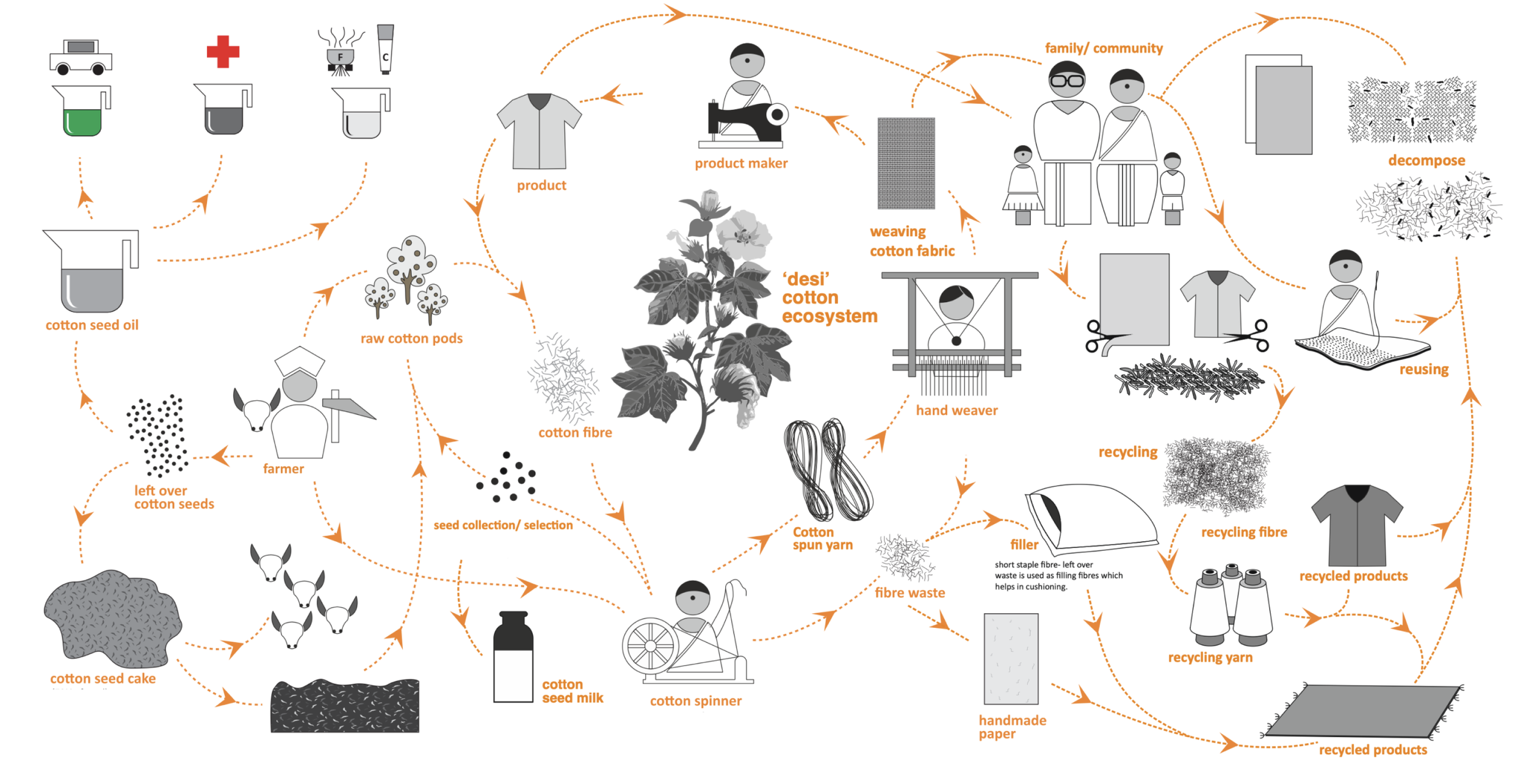
THE SYSTEMS WE WANT TO STRENGTHEN
Local materials. Human skills. Living ecosystems.
We believe resilient futures can grow from the resources and knowledge already present in a place. When local materials, skills and complementary livelihoods are connected, communities can create value close to where they live- with less dependence on distant supply chains and systems that demand high capital and energy.
Our interest is in decentralised systems: many capable local units connected through relationships, shared learning and mutual support. Not every village needs to make everything. But people should be able to understand the larger system they are part of and have a say in shaping it.
For us, strengthening village economies is not only about creating products or jobs. It is about rebuilding relationships between people, land, resources and work.
WHAT WE QUESTION
Convenience is not always freedom.
The promise of zero maintenance and endless availability can distance us from the living world and from the care that keeps things useful.
Plants, homes, tools, textiles and traditions all need attention. Materials age, objects need repair, and practices grow through use. Yet we are increasingly drawn to products that promise to last without care, or to cheap things that can be quickly replaced.
When convenience becomes the only measure, maintenance begins to look like a burden. We lose the skills of looking after things, and with them the relationships that connect us to materials and place.
We want to ask different questions: Can we care for what we use? Can we repair before replacing? Can we value things that change and age? Can we understand the full journey of a product, including its eventual disposal?
EVOLVED KNOWLEDGE
Not every new idea is an improvement.
We want to understand what has evolved through generations of practice before deciding what needs to change.
Evolved knowledge is slow, grounded and collective. It comes from many hands and bodies over time- through observation, repetition, failure, adjustment and shared learning. A tool such as the pit loom is not simply one person's invention. It carries the accumulated understanding of people who have lived and worked with it.
Innovation can be valuable. But when it begins with an imagined problem and ignores the knowledge already present, it can displace rather than improve. A new frame or tool may look efficient, yet fail to understand the body, the material or the rhythm of the work.
Before changing something, we try to ask: Was this truly a problem? Who has already found a way? Have we spent enough time understanding the practice? Are we designing for the person doing the work- or for our own idea of what improvement should look like?
We are not against innovation. We believe it becomes meaningful when it listens to experience, respects context and grows from a real understanding of what exists.
Sometimes the smartest thing is not to invent something new, but to understand what already works.
HOW WE WORK
Observe. Practice. Learn. Improve. Share.
We do not begin by assuming we know the answer. Our understanding grows through involvement, reflection and the willingness to look again.
-
Spend time with people, materials and places. Listen, ask questions and understand the conditions before proposing change.
-
Handle the materials, use the tools and take part in the work. Experience what the process asks of the people doing it.
-
Test possibilities, make mistakes and adjust. Let improvements emerge from a deeper understanding of context.
-
Record what is learnt so that knowledge can be revisited, questioned, shared and developed further.
-
Bring together skills, resources and people to help local systems become more capable and resilient.
-
Come back to the work. What we understand today may change with the next experience. Learning is ongoing